Thursday, October 27, 2011

Oskar Schindler's factory/museum and Krakow ghetto

Schindler's "Emalia (enamel bowls, cups, cookware etc.)  Factory",  rebuilt into a great museum at 4 Lipowa Street. From 1948 to 2002 it had been used as a Polish telecommunications factory. Now recounts the 5 years of the Nazi occupation in Krakow through videos, photos, documents, settings, drawings etc.  It shows prewar Krakow, the German invasion in 1939, Krakow as the capital of Poland under the Nazi occupation, the sorrows of everyday living in the occupied city, family life, the wartime history of Krakow Jews, the resistance movement,  the underground Polish state, and lastly the Soviet capture of the city.  There is A LOT to see, read and listen to.  We were there for over 5 straight hours. The videos, most of which were interviews with the Jewish survivors were fascinating. They varied in length from 15 to 5 minutes (more or less) and were very well-done. One couldn't listen to all of them but we did a good job of listening to many.


Plaque on the factory

The main medieval square, which I posted many photos of before, is called in Polish Rynek Glowny. The Germans under their occupation called it  first alter Markt and then Adolf-Hitler Place. Original signs.

Tile floor in one room of the museum. this was added for the museum but was very effective

Schindler's original office. Furnishings and map were all preserved and are original.

Enamelware produced in factory much of which was often traded in black markets for other goods but primary purpose was cookware for German soldiers.


 Ghetto (translated as Ghetto Heroes Square), before 1948 known as Plac Zgody,
 about 500 meters from Schindler's factory- where the jews were all forced to live in March of 1941.  Ghetto was next to the industrial area with many plants where the jews were used as cheap forced laborers. The residents of this Podgorze borough were forced to move to make way for the 17,000 jews who were sent here by the Germans. The other 65,000 jews who had been in krakow had already been moved out or left for other cities.  the Plaszow concentration camp was near by. And the adjoining Zablocie train station facilitated future deportations.

Large ghetto square. The ghetto was walled off with 4 gates, guarded by Germans. 4 Jewish families would share one flat. The chairs are a monument and are placed all over the square, 30+ large and 30+ smaller ones  in remembrance of  the Jew who had all their possessions thrown out on the street as they were being deported by the SS to death camps.  Germans closed the ghetto in 1943 after all the Jews had been moved out in 3 stages.
Monument was built in Dec 2005 
 Pharmacy (original) in ghetto, right across from ghetto.  The pharmacist (Only non-jew who lived in the ghetto) and his 3 woman  Polish helpers were part of the Polish resistance.  They also were  risking their lives  by allowing notes to get out to relatives of the jews inside medicines, they had food smuggled in etc.

Train crossing the river from Podgorze area (area of the ghetto and industrial plants). We walked over the river to get back to our hotel as it was very close.
It was raining slightly the day we visited the museum and the ghetto. there is a great bike/walking path around krakow, along the  Wisla river although we never had time to explore it.

Back across the river to the Kazimierz district and the historical Jewish Quarter - 5 minutes from our hotel was the oldest synagogue in Krakow. It is now a museum, with mostly photographs.  We tried twice to get in but it was closed and then closed for Yom Kippur.

original gate of factory (front of car)


Was another intense day of touring but I would recommend this museum to anyone. Very well -done and one learns a tremendous amount.

Tuesday, October 25, 2011

Wawel Castle area krakow

side chapel in cathedral, gorgeous  tombs

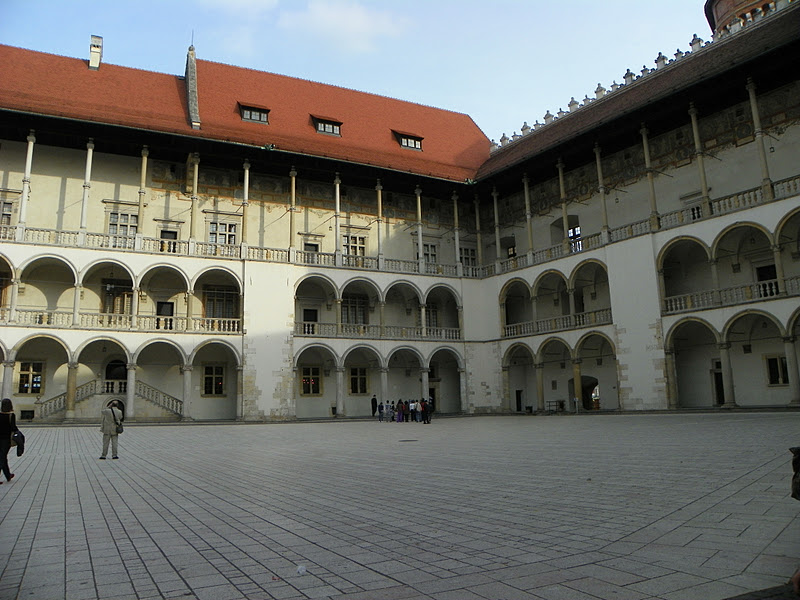
courtyard in castle area


courtyard detail

the three travelers

view of castle with ruins off to the right

lovely castle grounds, with great walls dating back many centuries

view of castle from street side
On the castle grounds artifacts going back to the 9th century have been found. Polish royals lived in the castle from the 11th to the 16th century. However, it was during the reign of Kazimierz the Great (1333-70) that the castle was truly born. A fire in 1499 destroyed much of this, yet also paved the way for Cracow's first taste of the Renaissance. The cathedral is the burial place for many of the Polish kings and queens as well as famous Poles. It has many different styles, renaissance, gothic, baroque etc. There is a burial crypt which we did not visit, nor did we visit the state rooms. we were at the end of a long day and felt the need to get home and have a nap!

An Umbrian fall weekend oct 21-23, 2011

it's really fall

newly purchased goat cheeses from our visit to a great goat cheese making farm just outside Orvieto

great wooden barn filled with ...goats

happy and friendly goats

the "stagionato" (aged) goat cheeses. young couple has taken on this endeavor and have been producing a small production of cheeses for two years now.

our purchases all wrapped up so pretty

another friendly fellow

view of entire town of orvieto

a very fruitful quince tree and we enjoyed really yummy stewed quinces

cavolo nero in the garden, my favorite

such a great view to wake up to, low lying clouds among the hills

the garden of the giant cabbages

looks like pears but it isn't, don't remember the name of this exotic fruit

had the great pleasure of biting into one of these and it was fall in one bite! delicious

freshly harvested lettuce from the wonderful garden
a weekend with friends at their fabulous umbrian abode. Perfect fall weather, gorgeous views, energetic walks, some wood chopping making larger logs into "boutique pieces of wood",  fabulous meals which came from a weekend of living off the land! what could be better?

Thursday, October 20, 2011

walking through Krakow's old city Oct 2011

 Stained glass window of the Franciscan church in the old city.  Church originally built in 1260, it burned down in 1850  and was completely rebuilt. The amazing interior (photos below) is something I have never, ever seen in a church, designed by a Polish artist. It is something of a miracle that the Franciscans let  Stanislaw Wyspianski, the artist, loose on the entire interior (they did in fact reject some of his motifs for angels, which he wanted to paint as modern day street urchins)!

He designed not only the murals that cover the interior of the church, but also the magnificent stained glass windows, all of which had incredible, colorful flower designs, very much art nouveau. The result is extraordinary. The entire interior is ablaze with bright murals - roses and poppies swirl about in blues, greens and yellows, among the crucifixes, statues of saints etc.

He started his commission on the interior design and the designing of the stained glass in 1897. THe glass was made in Austria from about 1899-1904. wish I had taken more photos, the stained glass was so amazing.
part of a wall detail

another wall, the entire wall was like this inside the church!!

camera couldn't get the crucifix and all the designs in the photo but you get the idea

another part of a wall

one of the beautiful buildings in the old town on Ulica (Street) Kanonicza, a lovely street 

The Church of Sts. Peter and Paul (Kosciól swietego Piotra i Pawla)  is a Baroque Jesuit church known best for the statues of the 11 disciples (minus Judas)  lining the fence at the front. Statues are copies made from the 18th century originals. Church is said to be modeled after the Jesuit Church in Rome (The Gesu'). I must admit there was a resemblance.
 St Andrew's Church, one of the oldest buildings  in Krakow built from 1079-1098  and one of the best preserved Romanesque buildings in Poland.  It is a rare surviving example of the European fortress church used for defensive purposes. Interior (at least what one could visit) is very small and very baroque not nearly as interesting as the outside.


This was a great wall mural on Ulica Kanonicza 

A great, glass sign for a book store (next to the wall  book mural).

Lovely doorway on same street

Pope John Paul lived on this street, (again Ulica Kanonicza) for 16 years and despite the sign Papal knick knacks were not all on display in the city. Rome is inundated with tourist shops with such material.  The Pope lived, studied, was bishop and then archbishop of Krakow before he left for Rome.

Pope's living quarters on this very lovely street.

Friday, October 14, 2011

Krakow on a lighter note: main square and more

inside gothic church in main square.  main altar was very elaborate and had a sculpted altarpiece with about 9 scenes from the life of the virgin, done in the 1400's, took 12 years to do. was made of beautiful oak and linden wood. was very pretty.

brick and stone tower from town hall. town hall was
unfortunately demolished in 1820 to make more room in the square and only the tower remains. first clock in tower dated 1524

view of gothic basilica. Bazylika Mariacka  with double spires, gothic tower 1478 and smaller renaissance tower 1590
Renaissance stone framework  holding the torah in the Remuh synagogue, which is the smallest of about 6 in the city and one of only two which are still in use. it was under restoration when we visited. it only had about 6 pews in it. Synagogue was built in 1558 


cemetery attached to remuh synagogue, in use from 1551-1800. the curved roofs you can see over some of the graves were added to protect the graves. the nazis destroyed the cemetery but it has been restored and they think there still may be many more graves underground.

pretty baroque architecture leading to main piazza

baroque theatre built in late 1800's
city walls and gate

Barbican for defense, late 15th century, used to be surrounded by a moat

mariacka church

pretty building on main square

lovely outside  colonnade of the "Sukiennice", market for merchants, now used as tourist shops inside. Colonade was added to building much later around 1800's.

outside of Sukiennice built in 1555 and was for merchant trading. you can see the arches under which was the colonnade (above photo)
Krakow's main square called  Rynek Główny dates back to the 13th century. It is huge, 40,000 m2 and is the biggest medieval square in Europe. It at least two churches in it, they may have been a third, the town tower, the merchant building and many other lovely buildings which are now shops or restaurants. there is only one statue of a Polish romantic poet from the 1800's. Very pretty to stroll around in.